Home / Pest Library / Ants

Ghost, fire and carpenter ants · Tampa Bay, Florida

Ants: tiny, organized, and very into your kitchen.

Nuisance trails in kitchens, painful stings outdoors, and structural risks from carpenter ants. If you live in Florida, you’re not if-ing about ants. You’re when-ing.

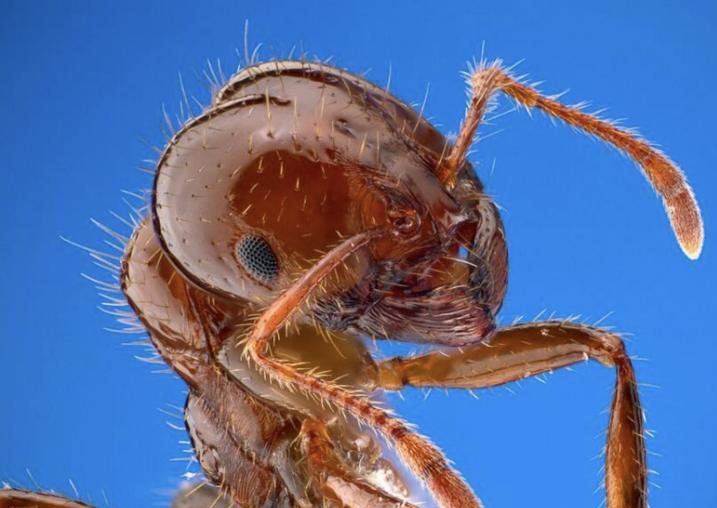
Close-up of a red imported fire ant worker
Red imported fire ant worker. Photo: Insects Unlocked, University of Texas at Austin (CC0), via Wikimedia Commons.

Quick facts

Danger
Fire ant stings; carpenter ant structural risk
Season
Year-round; peaks spring through fall. Carpenter ant swarmers show up April to June.[3]
Common areas
Kitchens, baths, lawns, wall voids
Treatment
Baits plus precise non-repellents

Risk meter

Nuisance High
Health Medium (fire ants)
Property Low to medium

Meet the usual suspects

University of Florida entomologists list more than a dozen ant species that regularly bug Florida homes.[1] In Tampa Bay, three of them do most of the damage to your peace of mind.

Ghost ants

Tapinoma melanocephalum

  • About 1 mm long. So small and pale you’ll swear they’re walking dust.[2]
  • Dark head and thorax, see-through abdomen and legs.[2]
  • Usually nest outside and forage inside, especially for sweets in kitchens and bathrooms.[2]
Nuisance

Fire ants

Solenopsis invicta

  • The most notorious of Florida’s two fire ant species.[4]
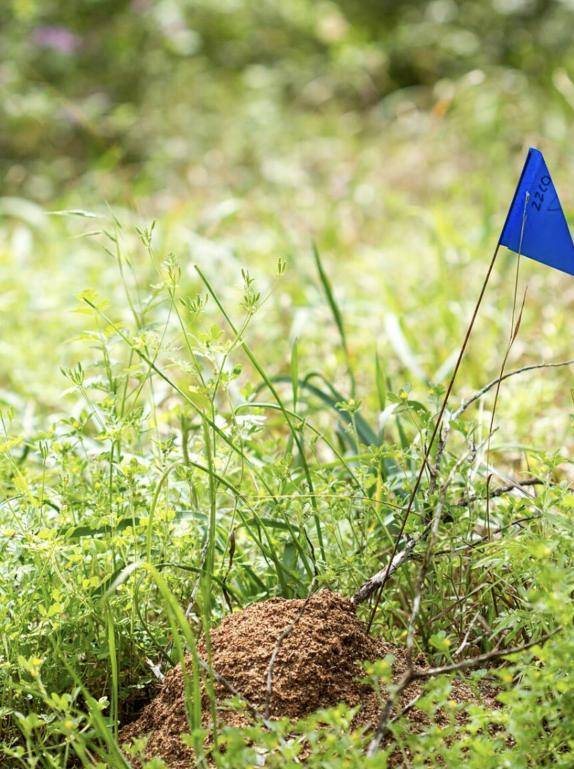
  • Build loose, crumbly soil mounds in sunny spots: lawns, sidewalks, playgrounds.
  • Sting in groups. For kids, pets and anyone with allergies, that can get serious.
Stings

Florida carpenter ants

Camponotus floridanus

  • They don’t eat wood. They excavate it to raise their young.[1]
  • Night shift workers: busiest from just before sunset to two hours after, and again around dawn.[3]
  • Love to trail along wires and tree branches that touch your house.[3]
Property risk

Science says

A little ant biology goes a long way. These facts are exactly why we treat ants the way we do.

1930s

Fire ants are not from around here

Red imported fire ants arrived from South America through the port of Mobile, Alabama, in the late 1930s, then hitchhiked across the South in shipments of nursery stock.[5] They’ve been ruining picnics ever since.

500,000

One mound, a small city

A mature fire ant colony can hold 100,000 to 500,000 workers.[6] Queens can live two to six years, and a new worker goes from egg to adult in about 22 to 38 days.[7]

Split!

Why spraying can backfire

Ghost ants, pharaoh ants, Argentine ants and some fire ants spread by “budding”: part of the colony simply moves out and starts a new one.[1] Spook them with a repellent spray and you can end up with more nests, not fewer.

Bait wins

Feed the queen (on purpose)

Baits work slower than drenches, but they’re more effective: workers carry the bait home and feed it to the queen and brood, which takes out the colony instead of just the ants you can see.[7]

Signs of an infestation

  • Trailing ants along baseboards, counters, or exterior foundation
  • Small soil mounds (fire ants) in lawns or around sidewalks
  • Sawdust-like frass or faint rustling sounds from walls (carpenter ants)
  • Winged ants near windowsills and sliding glass doors in spring, a classic carpenter ant swarm sign[3]

Prevention tips for Florida homes

  • Seal gaps around utility lines, window frames, and weep holes. Tiny ants fit through tiny openings.[1]
  • Trim vegetation 12 to 18 inches off the home and eliminate mulch-to-siding contact
  • Trim branches that touch the roof; carpenter ants use them as bridges[3]
  • Keep food sealed, wipe up sugars and oils, and fix moisture leaks promptly
  • For lawns, reduce over-irrigation that favors fire ant mounds
A fire ant mound in a grassy field
A fire ant mound. Photo: Alex Wild, Insects Unlocked, University of Texas at Austin (CC0), via Wikimedia Commons.

OrganoBug’s hybrid eco approach

  1. Identify and map

    We map trails and colonies and confirm the species: ghost vs. fire vs. carpenter.

  2. Targeted baits

    Baits and non-repellent placements indoors and at entry points, so ants carry it home.

  3. Precise perimeter work

    Micro-applications focused on nesting zones, not blanket sprays.

  4. Follow up and adjust

    We return free if activity persists between visits.

Frequently asked questions

Are Florida fire ants dangerous?

Fire ants can sting and inject venom, causing burning pain and swelling. For kids, pets, or those with allergies, stings can be serious. We target mounds and trails with reduced-risk products and baits.

What’s the fastest way to get rid of ghost ants indoors?

Avoid spraying baseboards with repellents. Ghost ants split colonies when disturbed. We use non-repellent baits and precise placements so they carry it back to the nest.

Will the treatment affect my pets?

Our hybrid approach prioritizes targeted, low-impact applications and baits placed out of reach. We’ll guide you on simple prep like picking up pet bowls during service.

How soon will I see results?

Trail activity often drops within 24 to 48 hours. For established colonies (carpenter or fire ants), full control may take 7 to 14 days as baits circulate through the colony.

Do carpenter ants eat my house?

No. Florida carpenter ants don’t eat wood; they hollow it out for nesting space.[1] The bigger worry is that they often move into wood that’s already damp or damaged, which is worth having checked.

Schedule an ant inspection

Tampa Bay and nearby. If they come back, we come back free.

Sources and photo credits

  1. UF/IFAS Extension, “Ants” (IG080, from Pests in and around the Southern Home). edis.ifas.ufl.edu/publication/IG080
  2. Koehler, Pereira and Castner, “Pest Ants” (IN018), UF/IFAS EDIS. edis.ifas.ufl.edu/publication/in018
  3. UF/IFAS Extension, “Florida Carpenter Ants” (IN1075). edis.ifas.ufl.edu/publication/in1075
  4. Collins and Scheffrahn, “Red Imported Fire Ant, Solenopsis invicta” (EENY-195 / IN352), UF/IFAS EDIS. edis.ifas.ufl.edu/publication/IN352
  5. USDA Forest Service research paper on imported fire ants in the United States. research.fs.usda.gov
  6. Oklahoma State University Extension, “Red Imported Fire Ants.” extension.okstate.edu
  7. Arnold, “Fire Ants: Spreading Like Wildfire,” UF/IFAS Extension Gadsden County (2022). nwdistrict.ifas.ufl.edu

Photos: Insects Unlocked, University of Texas at Austin, released into the public domain (CC0) via Wikimedia Commons. Facts are summarized in our own words from the publications above. OrganoBug is not affiliated with or endorsed by the University of Florida.