Brown widow
Latrodectus geometricus
- Light tan to dark brown, with an orange hourglass underneath.
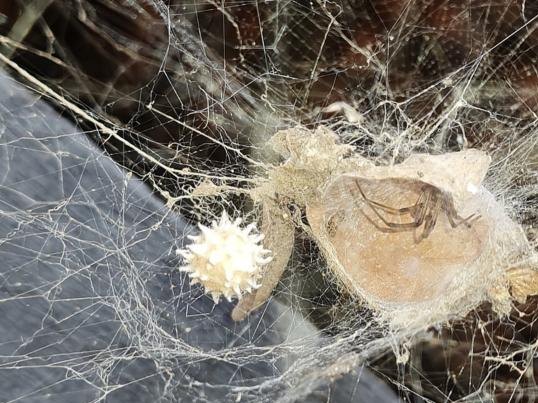
- Its egg sac is the giveaway: round, beige, and covered in little spikes.[3]
- Loves the undersides of patio furniture, railings, and mailboxes.

Home / Pest Library / Spiders
Widows, orb-weavers, wolf and house spiders · Tampa Bay
Helpful insect-eaters outdoors, unwelcome roommates indoors. In Tampa Bay, spiders are active year-round and gather around lights, eaves, and pool cages. We keep them out, safely.
Spiders are arachnids that feed on insects and generally avoid people. Web-builders (orb-weavers, house spiders) anchor webs near lights and sheltered corners to catch flying pests. Ground hunters (wolf, jumping, huntsman) roam along baseboards and storage areas.
Widow species hide in protected cavities: under patio furniture, in meter boxes, and in soffit corners. Spiders come inside to follow prey or seek shelter, especially during weather shifts.
Florida is home to four widow spiders: the southern black widow, northern black widow, red widow, and brown widow.[2] Here’s how to tell the two you’re most likely to meet.
Latrodectus geometricus
Latrodectus mactans
Many species
Spiders get a bad rap. The science is mostly reassuring, with a couple of important exceptions.
UF/IFAS notes that almost all spiders are harmless to humans, and most won’t bite unless provoked.[1]
Four widow species live in Florida: southern black, northern black, red, and brown widows.[2]
A widow lays roughly 250 eggs per sac, guards it aggressively, and the eggs hatch in about 20 days.[1]
Most spiders take about a year to mature, and their eggs hatch two to three weeks after they’re laid.[1] Knocking down egg sacs breaks the cycle.
Species ID matters: widows vs. harmless web-builders, indoor vs. outdoor pressure.
On eaves, pool cages, railings, and corners, to break the life cycle.
Reduced-impact products in cracks, soffit voids, utility penetrations, and garage harborages. No blanket interior sprays.
Precision exterior perimeter service; fewer moths and flies means fewer spiders.
Repair screens, install door sweeps, caulk gaps, and recommend lighting changes.
We re-inspect and fine-tune; if activity persists between visits, we return at no charge.
Most aren’t. They help control insects. Widow species can deliver medically important bites; we identify and treat those areas carefully.
Brown widow (common outdoors under furniture and railings) and black widow (in protected cavities). Orb-weavers and house spiders are typically harmless.
Brown recluse is not established in Florida; confirmed cases are rare and often involve transported items. We inspect and identify before treating.
Our service focuses on de-webbing and precise, reduced-risk applications in targeted harborages, with simple re-entry guidance.
You’ll notice fewer webs immediately after de-webbing. Activity typically drops over 1 to 3 weeks as harborages are treated and prey insects decline.
Lights attract moths and flies, their food. Adjusting lighting and sealing gaps cuts both insects and spiders.
Foggers rarely reach the crevices where spiders hide and can scatter activity. Targeted professional methods are more effective and safer.
Tampa Bay and nearby. If activity persists between visits, we come back free.
Photo: Tiago Lubiana, released into the public domain (CC0) via Wikimedia Commons. Facts are summarized in our own words from the publications above. OrganoBug is not affiliated with or endorsed by the University of Florida.