
Home / Pest Library / Drywood Termites
West Indian and southeastern drywood termites · Tampa Bay
Drywood termites: they’re already inside the wood.
Silent wood-destroyers that live inside dry, sound lumber. They don’t need soil, so they can infest attics, trim, and even furniture. Early detection prevents costly repairs.
Quick facts
- Danger
- Progressive structural damage to framing, trim, and furniture; hard to detect until advanced.
- Season
- Swarms most common spring and summer, sometimes into fall, often at dusk or at night after rain.
- Common areas
- Attics and rafters, fascia and soffits, window and door frames, baseboards, hardwood floors, garage door headers, and wooden furniture.
- Treatment
- Precise gallery injections (foam or dust), borate wood treatments, and sealing of entry points. Whole-structure options (tent fumigation or heat) for widespread activity. We inspect after treatment and adjust as needed.
Risk meter
Description and behavior
Drywood termites nest entirely inside dry, sound wood, with no soil contact or mud tubes. Colonies are smaller than subterranean termites but expand slowly and silently.
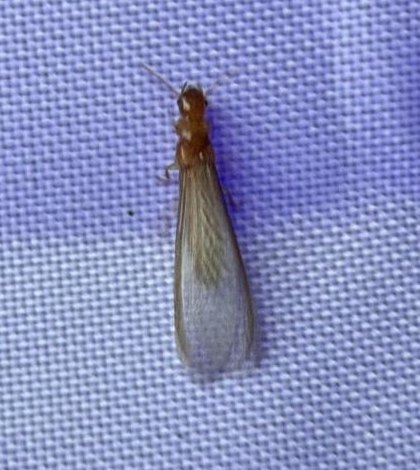
They create tiny “kick-out” holes to push out six-sided fecal pellets (frass). Winged swarmers are drawn to lights and start new colonies by squeezing into gaps around eaves, rooflines, trim, vents, or cracked paint.
Signs of an infestation
- Piles of hard, sand-like pellets that look like pepper or coffee grounds under trim or furniture
- Tiny, round kick-out holes on finished wood surfaces
- Blistered paint, hollow-sounding or splintery wood
- Discarded wings on windowsills or near lights
- Swarmers with equal-length wings in spring or early summer, often at dusk
Science says
Drywood termites leave one very specific calling card. Here’s how UF scientists read it.
The pellet tells the story
A telltale sign of drywood termites is a pile of six-sided fecal pellets.[1]
Kick-out holes
Pellets are pushed out through tiny kick-out holes about 1 to 2 mm across, and the piles look like sawdust or coffee grounds.[1]
The furniture termite
The West Indian drywood termite often attacks small items like table legs and picture frames, so it travels easily from home to home.[1]
Colonies in one door
Researchers have recorded twenty separate colonies living in a single wooden door.[2]
Prevention tips for Florida homes
- Seal exterior cracks and gaps around eaves, fascia, soffits, windows, and doors, even hairline ones
- Keep exterior wood painted or sealed; replace weathered or water-damaged boards
- Screen attic and soffit vents with fine insect screen
- Reduce night lighting near entry points during swarm season or switch to yellow bulbs
- Trim trees and shrubs so they don’t touch the house
- Inspect firewood and second-hand wooden furniture before bringing it inside
OrganoBug’s hybrid eco approach
Inspect and confirm
Identify drywood vs. subterranean activity, find kick-out holes and pellet piles, and map every affected area.
Targeted gallery treatment
Precise foam or dust injections directly into active galleries, so the treatment goes where the termites are.
Borate protection
Borate treatments on accessible, unfinished wood to protect against new colonies.
Seal entry points
Caulk, paint, and screen the gaps swarmers use to get in.
Whole-structure options when needed
For widespread or hidden activity, we coordinate tent fumigation or heat through licensed partners and walk you through prep.
Follow up and monitor
Clean up pellet piles, recheck for fresh frass, and set periodic inspections.
Frequently asked questions
How do I tell drywood from subterranean termites?
Drywood termites live in wood and push out hard, six-sided pellets through small holes, with no soil tubes. Subterranean termites build mud tubes from the ground and need soil moisture.
Are drywood termites dangerous to my home?
Yes. Damage builds slowly but steadily and can compromise trim, doors, floors, and even framing if ignored.
Do I need tent fumigation?
Not always. Localized treatments work well for contained colonies. Whole-structure fumigation or heat is best when activity is widespread or hidden.
How soon will I see results?
After localized treatment, activity typically drops over 2 to 6 weeks. Fumigation kills active colonies immediately but doesn’t prevent future infestations.
Will treatment affect my kids or pets?
Localized work uses precise, reduced-risk applications into wood, with clear re-entry guidance. Whole-structure options require temporary vacancy.
Do DIY sprays work?
Surface sprays rarely reach hidden galleries and can scatter colonies. Professional identification and targeted treatment is the reliable fix.
Found pellets? Let’s take a look.
We’ll confirm what you have, treat it precisely, and help keep new colonies out.
Sources and photo credits
- “Drywood and Dampwood Termites” (ENY-217 / IG098), UF/IFAS EDIS. edis.ifas.ufl.edu/publication/IG098
- Scheffrahn and Su, “West Indian Drywood Termite, Cryptotermes brevis” (EENY-079 / IN236), UF/IFAS EDIS. edis.ifas.ufl.edu/publication/IN236
Photo: IDClaire, CC BY 4.0, via Wikimedia Commons. Facts are summarized in our own words from the publications above. OrganoBug is not affiliated with or endorsed by the University of Florida.