
Home / Pest Library / Bed Bugs
Cimex lectularius · Tampa Bay, Florida
Bed bugs: the worst souvenir you’ll ever bring home.
Night-biting hitchhikers that ride in luggage, furniture, and clothing. They hide in seams and cracks, then feed while you sleep. Fast, discreet solutions that actually work.
Quick facts
- Danger
- Itchy bites, allergic reactions, anxiety and lost sleep. Not known to transmit diseases.
- Season
- Year-round in Florida; spikes with travel and moves (summer and holidays).
- Common areas
- Mattress and box spring seams, bed frames and headboards, baseboards, couches, recliners, outlets, luggage, nightstands.
- Treatment
- Detailed inspection, vacuuming and steam, crack-and-crevice applications, encasements, interceptors, and scheduled follow-ups. Whole-home heat for heavy cases.
Risk meter
Description and behavior
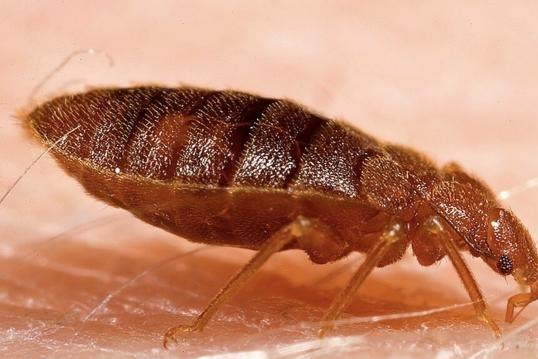
Bed bugs (Cimex lectularius) hide in tight spaces near where people rest. They feed at night, leaving small, painless bites that may become itchy welts in lines or clusters (not proof by themselves).
They spread by hitchhiking on luggage, furniture, laundry, or guest belongings. Eggs hatch in about 6 to 10 days at room temperature, so untreated populations can build quickly.
Signs of an infestation
- Dark, pepper-like fecal spots on sheets, seams, or baseboards
- Shed skins, eggs, or live bugs in mattress seams and furniture joints
- Small blood spots on bedding or pajamas
- A musty or sweet odor in heavy infestations
- Bites after sleep (patterns vary and are not proof by themselves)
Science says
Bed bugs have been bothering humans for thousands of years. Here’s what the entomologists have learned.
Apple-seed sized, until dinner
Unfed adults are brown and about 6 to 9.5 mm long. After a meal they swell up and turn red.[1]
Eggs that stay put
Eggs are laid on rough surfaces and coated in a clear cement, which is why they’re so hard to brush or vacuum away.[1]
A DIY dead end
UF/IFAS notes that total-release foggers are not effective against bed bugs.[1] They don’t reach the cracks where bed bugs actually live.
Prevention tips for Florida homes
- Dry bedding and clothes on high heat (30 minutes or more) after travel; inspect luggage before storing
- Use mattress and box-spring encasements and bed-leg interceptors
- Keep beds pulled 3 to 6 inches from walls; don’t let bedspreads touch the floor
- Declutter bedrooms; store items in sealed bins rather than cardboard
- Inspect second-hand furniture carefully; skip curbside finds
- In apartments and condos, report early. Bed bugs infest homes, hotels, dorms, and even cruise ships,[2] and building-wide action prevents spread.
OrganoBug’s hybrid eco approach
Confirm and map
Careful inspection, monitor placement, and education on where activity is concentrated.
Prep guidance
A clear, simple checklist: launder and dry on high heat, reduce clutter without spreading bugs, bag items.
Mechanical removal
Precision vacuuming and high-temperature steam on seams, tufts, and cracks.
Targeted applications
Reduced-impact residuals and dusts in voids, cracks, and furniture joints. No blanket sprays.
Protect and monitor
Encasements and bed-leg interceptors; we adjust furniture positioning.
Follow-ups
Re-inspect and retreat at 7 to 10 day intervals until activity stops. Whole-home heat available for severe cases.
Frequently asked questions
Do bed bugs carry diseases?
They’re not known to transmit diseases to humans, but bites can cause itching, allergic reactions, and stress.
Where did they come from?
Almost always via travel, visitors, used furniture, or shared laundry or transport.
Will I need to throw out my mattress?
Usually not. Encasements plus professional treatment often save beds and furniture.
How fast will I see results?
You should notice fewer bites after the first visit; complete control typically takes 2 to 3 follow-ups spaced 7 to 10 days apart.
Are treatments safe around kids and pets?
We rely on steam, vacuuming, encasements, and precise, reduced-impact products in hidden areas, with clear re-entry guidance once dry.
Can I treat this myself?
DIY sprays and foggers often miss hidden eggs and can spread bugs. Integrated professional methods are far more reliable.
I live in a multi-unit building. Now what?
Tell management right away. Coordinated inspections and treatments stop units from re-infesting each other.
Schedule a bed bug inspection
Tampa Bay and nearby. If they come back, we come back free.
Sources and photo credits
- Brooks, “Bed Bug, Cimex lectularius” (EENY-140 / IN297), UF/IFAS EDIS. edis.ifas.ufl.edu/publication/IN297
- Koehler, Pereira, Lehnert and Hertz, “Bed Bugs and Blood-Sucking Conenose” (ENY-227 / IG083), UF/IFAS EDIS. edis.ifas.ufl.edu/publication/IG083
Photo: CDC / Harvard University, public domain, via Wikimedia Commons. Facts are summarized in our own words from the publications above. OrganoBug is not affiliated with or endorsed by the University of Florida.