
Home / Pest Library / Earwigs
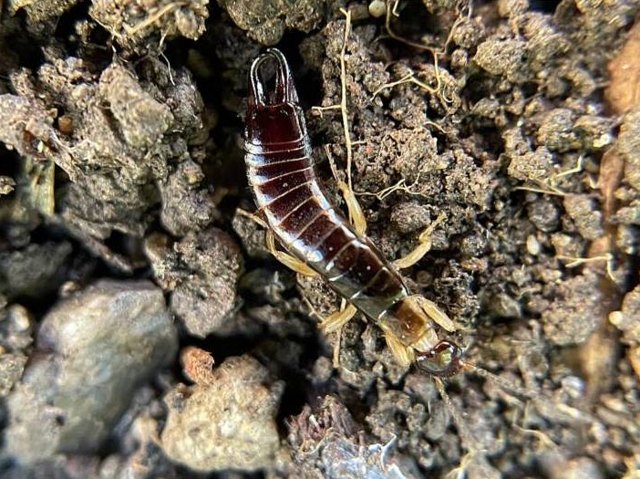
Ringlegged earwig and friends · Tampa Bay
Earwigs: all pincers, no real threat.
Night-active moisture lovers with scary-looking pincers, but mostly just a nuisance. We fix moisture and hiding spots first, then use precise, eco-smart methods to keep them out.
Quick facts
- Danger
- Nuisance only. No venom or disease; pincers can pinch if handled. Plant nibbling and indoor sightings are the main issues.
- Season
- Year-round in Florida; spikes late spring through fall and after heavy rain or irrigation.
- Common areas
- Mulch beds, under pots, rocks and tarps, woodpiles, leaf litter, door thresholds, garages, bathrooms, kitchens, exterior wall voids, sliding-door tracks.
- Treatment
- Moisture and habitat correction, exclusion and sealing, mechanical trapping, targeted reduced-impact baits, and desiccant dusts in voids. No blanket interior sprays.
Risk meter
Description and behavior
Common Tampa species hide in cool, damp places by day and forage at night on decaying matter, insects, and tender plants. They’re drawn to thick mulch, leaky irrigation, and shaded clutter.
After storms or drought, they may wander indoors through gaps at doors, garage seals, and weep holes. And no, the “into your ear” story is a myth.
Signs of an infestation
- Earwigs scattering when you lift mulch, pots, or stones
- Pincher-tailed insects in bathrooms, kitchens, or garages at night
- Chewed seedlings or soft plant growth near foundation beds
- Activity clustered along moist, shaded edges and downspouts
Science says
Earwigs have a reputation problem. Here’s what UF researchers actually found.
Florida’s most common earwig
The ringlegged earwig is the most common earwig in Florida, and probably the only one that could be called a pest.[1]
A secret pest-eater
It’s a hungry predator of insects and sowbugs, which likely offsets the little plant damage it does.[1]
A surprisingly good parent
Females guard their eggs from mites, fungi, and intruders, cleaning and moving them if needed.[1]
Prevention tips for Florida homes
- Keep mulch 2 to 3 inches deep and pull it 6 to 12 inches back from the foundation
- Redirect downspouts; avoid nightly over-watering and fix leaks
- Store firewood and pots off the ground; remove leaf litter and ground tarps
- Add gravel or rock borders along beds to create a dry perimeter
- Repair door sweeps and weather-stripping; screen weep holes and vents
- Reduce night lighting or use warm or yellow bulbs
- Keep cardboard off garage floors; use sealed plastic bins
OrganoBug’s hybrid eco approach
Identify and map
Confirm species and pressure zones: mulch beds, downspouts, door tracks, garages.
Fix conditions first
Correct irrigation schedules, improve drainage, reduce mulch depth, and clear ground-contact clutter.
Seal and exclude
Door sweeps, weather-stripped thresholds, screened weep holes and vents, caulked utility penetrations.
Targeted, low-impact controls
Reduced-impact baits in exterior harborages and desiccant dusts in voids. No blanket indoor spraying.
Mechanical trapping and lighting
Night traps in hot spots, plus warm bulbs and smarter placement near entries.
Follow up and adjust
Re-inspect in 2 to 3 weeks and set a seasonal plan before peak months.
Frequently asked questions
Are earwigs dangerous?
No. They don’t sting or spread disease. Pincers may pinch if handled but rarely break skin.
Why are they in my bathroom or kitchen?
Moisture and gaps. We address leaks, humidity, and entry points to stop indoor wanderers.
Will you spray my whole interior?
No. Our program focuses on moisture, exclusion, traps, and targeted applications in hidden harborages.
Do they damage plants?
They can nibble seedlings and soft growth. Habitat fixes and spot treatments protect beds without heavy residues.
How fast will I see results?
Most customers notice a sharp drop within 1 to 3 weeks as moisture is corrected and harborages are treated.
Will rain make them worse?
Yes. Storms push earwigs from waterlogged beds toward structures. We prep perimeter zones to prevent influxes.
Ready for earwig relief?
We’ll dry out the hot spots, seal the gaps, and apply precise, eco-minded treatments that last.
Sources and photo credits
- Capinera, “Ringlegged Earwig, Euborellia annulipes (Lucas)” (EENY-088 / IN245), UF/IFAS EDIS. edis.ifas.ufl.edu/publication/IN245
Photo: Daniel Das, released into the public domain (CC0), via Wikimedia Commons. Facts are summarized in our own words from the publications above. OrganoBug is not affiliated with or endorsed by the University of Florida.