
Home / Pest Library / German Cockroaches
Blattella germanica · Tampa Bay, Florida
German cockroaches: small, fast, and very good at math.
Small, fast kitchen roaches that multiply quickly in warm, tight spaces. We clean, seal, and bait with precision. No foggers or blanket cabinet sprays.
Quick facts
- Danger
- Contaminate food and surfaces; shed skins and droppings can trigger allergies and asthma.
- Season
- Year-round indoors; surges with warmth, clutter, moisture, and easy food.
- Common areas
- Behind and under refrigerators, dishwashers, stoves, microwaves and coffee makers; cabinet hinges, drawer slides, wall voids, under sinks.
- Size
- About ⅝ inch as adults, a fraction of a palmetto bug.[2]
Risk meter
Description and behavior
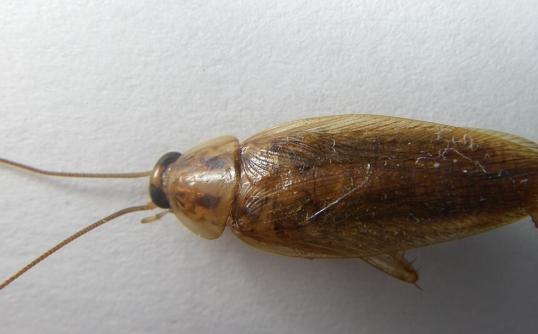
German cockroaches are tan to light brown with two dark stripes behind the head. They love tight cracks and breed indoors, often arriving in cardboard, used appliances, or deliveries.
They need water, warmth, and crumbs or grease, so kitchens and bathrooms are prime real estate. Seeing them in the daytime usually signals heavy pressure.
Signs of an infestation
- Small roaches scurrying when lights turn on, especially in kitchens and baths
- Pepper-like droppings and dark smears in cabinet corners, hinges, and under appliances
- Shed skins, egg cases, and a musty odor in severe infestations
- Activity spreading to bedrooms or living rooms (drawers, electronics) in heavy cases
Science says
Why do German roaches get out of hand so fast? The biology explains it.
Eggs per capsule
A typical German cockroach egg case holds 30 to 40 eggs[1], and some hold up to 48.[2]
Mom keeps the eggs close
Females carry the egg case until just before hatching, and babies often emerge while she’s still carrying it.[1] Fewer eggs lost means faster growth.
A steady production line
A female can produce about one egg case a month, around eight in her lifetime.[3] That’s why even one egg-carrying female is reason to act.
Small enough to hide anywhere
Adults are about ⅝ inch long.[2] They fit inside hinges, appliance motors, and electronics.
German roach or something else?
Small brown roaches aren’t all the same. Here’s how the common Florida look-alikes compare.
| Roach | Adult size | Where it lives | What it means |
|---|---|---|---|
| German cockroach | About ⅝ in[2] | Breeds indoors in kitchens and baths | An active indoor infestation |
| Asian cockroach | About ⅝ in[2] | Mostly outdoors; a strong flier drawn to lights[4] | Often a wanderer, not a resident |
| American cockroach | About 1½ in[2] | Sewers, drains, mulch | A palmetto bug: different plan entirely |
Prevention tips for Florida homes
- Nightly reset: empty the sink, wipe counters, sweep crumbs, and run the dishwasher
- Store food and pet food in sealed containers
- Replace cardboard with sealed plastic bins; don’t store paper bags in warm cabinets
- Clean drip pans, toaster crumb trays, and under and behind the fridge and stove
- Repair leaks, insulate sweating pipes, and let sinks dry overnight
- Caulk gaps at backsplashes, cabinet edges, and pipe cutouts
- Inspect deliveries and used appliances; unpack boxes outside the kitchen
OrganoBug’s hybrid eco approach
Identify and map hotspots
Confirm species; chart harborages (appliances, hinges, voids), moisture points, and food sources.
Sanitation and moisture fixes first
Degrease stove and hood areas, clean behind appliances, dry sinks nightly, fix leaks, declutter cardboard.
Mechanical removal
HEPA-vacuum live roaches, egg cases, and allergens; targeted steam where safe.
Targeted, low-impact controls
Professional gel baits deep in cracks and appliances, rotated to prevent aversion, plus growth regulators and void dusts. No blanket sprays.
Seal and exclude
Caulk cabinet gaps and utility penetrations; door sweeps where units share trash rooms.
Monitor and verify
Sticky monitors track reductions; we adjust until activity stops, and coordinate building-wide in apartments and condos.
Frequently asked questions
How are German cockroaches different from “palmetto bugs”?
German roaches breed indoors in kitchens and baths and are much smaller. American “palmetto bugs” are large and often come from sewers and outdoors. Control strategies differ.
Will one visit solve it?
Usually not. Expect 2 to 3 follow-ups over 2 to 4 weeks as egg cases hatch and growth regulators take effect.
Are foggers or sprays helpful?
Foggers scatter roaches and miss crevices; broad sprays can repel them from baits. We rely on bait rotations, growth regulators, void dusting, and sealing.
Is this safe for kids and pets?
Baits and dusts are placed in concealed cracks and voids; we provide simple re-entry and wipe-down guidance.
Do I have to throw out my microwave or coffee maker?
Rarely. We can vacuum, steam, and bait around appliances; in severe cases, temporary removal for cleaning may be advised.
Why do they keep coming back?
Unsealed gaps, moisture, crumbs and grease, and cardboard storage fuel rebounds. Our plan pairs treatment with condition fixes and monitoring.
Reclaim your kitchen
We’ll map the hotspots, clean and seal key areas, and apply precise, eco-smart treatments that last.
Sources and photo credits
- Valles, “German Cockroach, Blattella germanica” (EENY-002 / IN128), UF/IFAS EDIS. edis.ifas.ufl.edu/publication/IN128
- UF/IFAS Extension, “Cockroaches” (IG082, from Pests in and around the Southern Home). edis.ifas.ufl.edu/publication/IG082
- UF/IFAS EDIS, German cockroach fact sheet (IN1190). edis.ifas.ufl.edu/publication/IN1190
- UF/IFAS EDIS, “Asian Cockroach, Blattella asahinai” (IN277). edis.ifas.ufl.edu/publication/IN277
Photo: George Shuklin, public domain, via Wikimedia Commons. Facts are summarized in our own words from the publications above. OrganoBug is not affiliated with or endorsed by the University of Florida.