
Home / Pest Library / Mole Crickets
Tawny, southern and shortwinged mole crickets · Tampa Bay
Mole crickets: digging up trouble under your lawn.
Burrowing turf pests that tunnel through root zones and sever grass, especially in sandy, sunny spots. We fix irrigation and soil first, then use precise, eco-smart controls to stop the damage.
Quick facts
- Danger
- Rapid turf thinning, spongy or sunken areas, and mower scalping; costly re-sodding if ignored.
- Season
- Active year-round; heaviest injury late spring through fall. Adults fly to lights on warm, humid nights.
- Common areas
- St. Augustine, bahia, bermuda, and zoysia lawns; sunny edges along driveways and sidewalks, sandy soils, sports turf, and new sod.
- Treatment
- Irrigation and thatch correction, targeted nighttime baits in hot spots, beneficial nematodes and microbial tools where suitable, resistance-smart rotations, and follow-up monitoring. No blanket lawn sprays.
Risk meter
Description and behavior
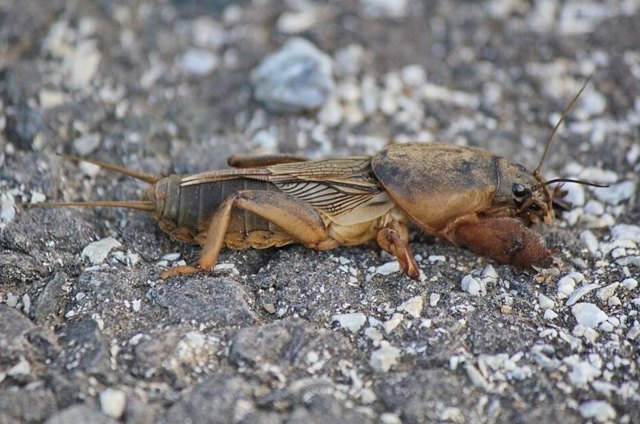
Tawny and southern mole crickets live in the soil, tunneling just below the surface and feeding on roots and shoots. Their galleries loosen soil so turf feels spongy and tears easily. Nymphs cause most of the damage as they grow in warm months.
Adults are strong fliers and often swarm to lights after rain. Activity concentrates in dry, sandy, and compacted areas with thick thatch or uneven irrigation.
Signs of an infestation
- Raised, winding tunnels or spongy turf that lifts like a carpet
- Brown patches that expand despite watering and fertilizer
- Birds, armadillos, or raccoons digging for crickets
- Nighttime chirping and adults flying to porch and yard lights
- A positive soap flush: 2 to 3 tablespoons of mild dish soap in a gallon of water over 1 square foot brings them up within minutes
Science says
These aren’t Florida natives, and they didn’t come here to make friends with your lawn.
Invaders from South America
Three non-native pest mole crickets live in Florida: the shortwinged, southern, and tawny.[1]
Built like tiny bulldozers
Adults are about 1½ inches long, light brown, with enlarged forelegs for digging.[2]
They sing for a date
Males attract females with a courtship song from their burrows early in the night.[3]
Prevention tips for Florida homes
- Mow right: St. Augustine at 3.5 to 4 inches; never remove more than a third of the blade
- Water deeply, not daily: ¾ to 1 inch per cycle; fix dry “missed” zones
- Reduce thatch and compaction: aerate and top-dress sandy soils; avoid heavy summer nitrogen
- New sod: keep seams tight and irrigation even; check with soap flushes the first warm season
- Swap bright night lighting over the lawn for warm or yellow bulbs
- Mulch or plant narrow hot strips along pavement; relieve compaction
OrganoBug’s hybrid eco approach
Identify and map hot spots
Confirm species and activity with soap flushes; mark edges, hot strips, and new-sod seams.
Fix conditions first
Irrigation coverage, thatch and compaction, mowing heights, and drainage. Healthy turf resists reinfestation.
Targeted, low-impact controls
Professional baits on active zones just after sunset, timed around rain and irrigation. No blanket broadcast.
Biological options
Beneficial nematodes selected for mole crickets and compatible microbial tools where soil and timing fit.
Rotations and lighting
Resistance-smart rotations plus lighting changes to reduce adult flights.
Follow up and monitor
Recheck in 2 to 3 weeks with fresh soap flushes; spot-treat holdouts and tune the plan for the season.
Frequently asked questions
Are mole crickets harmful to people or pets?
No. They don’t bite or sting. The risk is lawn destruction and costly replacement.
How do I tell mole crickets from chinch bugs or fungus?
Mole crickets leave raised tunnels and spongy turf, and soap flushes bring them up. Chinch bugs cause browning near pavement without tunnels.
Will you blanket spray my lawn?
No. We use condition fixes, targeted nighttime baits, and biologicals to protect beneficials and pollinators.
Do beneficial nematodes really help?
Yes, when matched to soil temperature and moisture and applied correctly, as part of an integrated plan.
When will I see improvement?
Activity typically drops within 1 to 3 weeks; turf recovery follows with proper irrigation and mowing.
Why do they come back every summer?
Thatch, dry sandy edges, and bright lights invite them. Cultural fixes plus targeted treatments break the cycle.
Rescue your lawn
We’ll confirm activity, correct the conditions, and apply precise, eco-smart treatments that last.
Sources and photo credits
- “Shortwinged, Southern and Tawny Mole Crickets, Neoscapteriscus spp.” (EENY-235 / IN391), UF/IFAS EDIS. edis.ifas.ufl.edu/publication/IN391
- UF/IFAS Ask IFAS, “Gryllotalpidae (mole crickets).” ask.ifas.ufl.edu
- Buss, “Pest Mole Cricket Management” (ENY-324 / LH039), UF/IFAS EDIS. edis.ifas.ufl.edu/publication/LH039
Photo: Kirospe, released into the public domain (CC0), via Wikimedia Commons. Facts are summarized in our own words from the publications above. OrganoBug is not affiliated with or endorsed by the University of Florida.