
Home / Pest Library / Powderpost Beetles
Lyctid, anobiid and bostrichid beetles · Tampa Bay
Powderpost beetles: the quiet ones are always trouble.
Silent wood borers that leave pin-sized “shot holes” and fine powdery frass. We focus on identification, moisture control, and targeted borate and heat solutions. No blanket sprays.
Quick facts
- Danger
- Progressive damage to hardwood trim, floors, furniture, cabinets, and sometimes softwood framing; reinfestation possible if conditions persist.
- Season
- Year-round in Florida; adult emergence and flight peak in warmer months.
- Common areas
- Baseboards, window and door trim, hardwood floors, stair treads and rails, cabinets, furniture, picture frames, attic framing and stored lumber, especially unfinished wood.
- Treatment
- Confirm the beetle family, lower wood moisture, apply borate to accessible wood, seal or finish vulnerable surfaces, local heat where appropriate, and replace severely damaged pieces. Whole-structure fumigation only for widespread, inaccessible activity.
Risk meter
Description and behavior
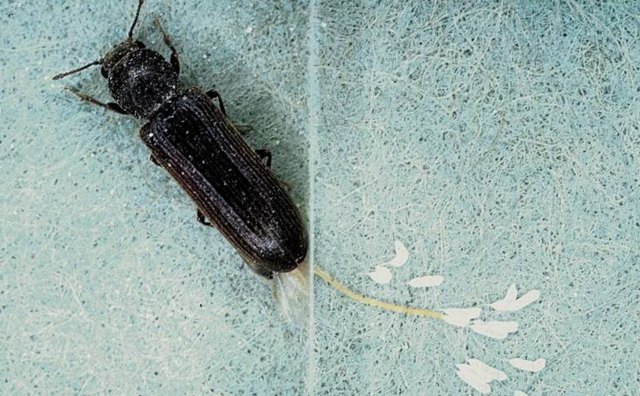
“Powderpost beetle” is a group name for several wood-boring beetles. Lyctids (true powderpost beetles) prefer hardwoods like oak, ash, and walnut, often in flooring, trim, and furniture. Anobiids attack softwoods and damp hardwoods in attics, crawlspaces, and garages. Bostrichids often arrive in imported or poorly dried wood.
Larvae tunnel for months to years, then emerge as adults, leaving small round exit holes. Fine, sifted frass collects beneath the holes: flour-like for lyctids, grittier for anobiids.
Signs of an infestation
- Tiny, round “shot holes” on finished wood surfaces
- Fresh piles of fine powder (frass) on floors, shelves, or inside cabinets
- New holes or frass reappearing after cleaning (active) vs. old, finish-coated holes (historic)
- Thinned veneers, blistering finish, or spongy galleries beneath the surface
- In attics and garages: powder collecting along joists or on stored lumber
Science says
The powder is the clue. Here’s how UF entomologists read it.
Lyctid frass is super fine
True powderpost beetle frass is extremely fine and feels like talc, packed loosely in the tunnels.[1]
Anobiid frass feels sandy
Anobiid frass is powdery but gritty to the touch, with cigar-shaped pellets.[1]
Exit holes the size of a pinhead
Lyctid adults chew out through round holes about 1 to 2 mm across.[2]
How they get in
Most beetle problems arrive in lumber or finished wood products like furniture, paneling, or flooring.[1]
Prevention tips for Florida homes
- Keep indoor humidity near 45 to 50%; ventilate attics and dehumidify garages and crawlspaces
- Repair roof, window, and pipe leaks promptly; don’t store damp lumber against walls
- Seal or finish exposed hardwoods, including furniture undersides and backs
- Buy kiln-dried lumber; inspect second-hand furniture before bringing it inside
- Store wood off the floor with airflow; avoid long-term storage in humid spaces
- Make sure bath and kitchen fans exhaust outside, not into the attic
OrganoBug’s hybrid eco approach
Identify and map
Determine the beetle family, age of damage, and moisture conditions; mark active vs. inactive areas.
Moisture and environment first
Ventilation, dehumidification, and leak repair. Keeping wood dry is the key to long-term success.
Targeted borate treatments
Treat accessible, unfinished or stripped wood. Borates penetrate and protect galleries, with no blanket interior sprays.
Seal and protect surfaces
Sand and finish hardwoods to deter reinfestation, especially lyctids that need open pores.
Localized heat or replacement
Controlled heat for furniture or small zones; replace pieces with severe structural loss. Fumigation through licensed partners only if truly widespread.
Follow up and monitor
Re-inspect at 6 to 12 weeks; mark holes and check for new frass to verify no new emergence.
Frequently asked questions
Are powderpost beetles like termites?
No. They’re beetles whose larvae tunnel in wood. Damage can be significant, but biology and treatments differ from termites.
How do I know if it’s active?
Fresh, silky frass that reappears after you clean, or new clean-edged holes, means activity. We mark suspect holes and recheck.
Will sealing wood stop them?
Sealing helps prevent reinfestation and pairs with borate and moisture correction to end current activity.
Can they spread to all my furniture?
Risk depends on wood type, finish, and humidity. Finished, well-sealed pieces are less vulnerable; we inspect piece by piece.
How long until they’re gone?
Frass typically stops within weeks after treatment and drying. We verify over a follow-up cycle.
Protect your hardwoods
We’ll identify the beetle, fix the conditions, and keep your home beautifully beetle-free.
Sources and photo credits
- Koehler, Oi and Andrews, “Powderpost Beetles and Other Wood-Infesting Insects” (ENY-266 / IG119), UF/IFAS EDIS. edis.ifas.ufl.edu/publication/IG119
- Koehler and Castner, “Wood-Destroying Insects” (SP193 / IN035), UF/IFAS EDIS. edis.ifas.ufl.edu/publication/IN035
Photo: USDA Forest Service Archive, Bugwood.org, CC BY 3.0 US, via Wikimedia Commons. Facts are summarized in our own words from the publications above. OrganoBug is not affiliated with or endorsed by the University of Florida.