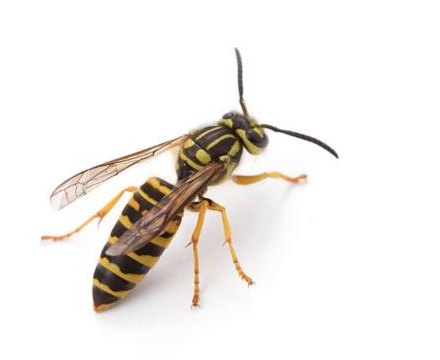
Yellowjackets
Vespula spp.
- Nest in the ground or in wall voids.
- Highly protective; drawn to outdoor food and trash.
- Colonies hold hundreds to thousands of wasps.[1]

Home / Pest Library / Stinging Insects
Yellowjackets, hornets, wasps and bees · Tampa Bay
Wasps, yellowjackets, hornets, carpenter bees, mud daubers: helpful in nature, risky near doors, decks, and play areas. We use eco-smart, pollinator-first methods to keep you safe.
Paper wasps build umbrella-shaped open combs under eaves and defend at short range. Yellowjackets nest in the ground or wall voids, guard them fiercely, and love outdoor food and trash. Baldfaced hornets build gray, football-shaped paper nests in trees and on structures.
Mud daubers make solitary mud-tube nests, rarely sting, and prey on spiders. Carpenter bees drill round holes in soft or unfinished wood. Honey bees are essential pollinators that occasionally nest in walls and soffits, and relocation is always our first choice.
Florida has two yellowjackets, the eastern and the southern, plus the baldfaced hornet, which is actually a yellowjacket too.[1] Here’s the lineup around Tampa Bay homes.
Vespula spp.
Polistes and Dolichovespula
Solitary wasps and bees
The more you know about stingers, the safer your summer gets.
Only two of the 18 North American Vespula yellowjacket species live in Florida: the eastern and the southern.[1]
Unlike honey bees, yellowjackets and hornets can sting again and again.[1]
Yellowjackets and hornets release an alarm pheromone that rallies the nest to defend it.[2]
Colonies are founded each spring by a single queen that mated the previous fall.[1] In Florida’s warmth, some nests keep going much longer.
Confirm species, nest size, flight paths, and any bloom or pollinator risks.
Honey bees get live removal and relocation with a licensed beekeeper; we manage access and sealing afterward.
De-nest tools and HEPA capture where appropriate, at dawn or dusk to reduce activity.
Low-impact applications directly into nest entrances and voids. No blanket perimeter or bloom spraying.
Patch soffit gaps, screen vents, cap posts, and seal raw wood to deter carpenter bees.
Re-inspect, remove new starter nests, and set a seasonal plan before peak months.
No. We avoid blooms and schedule services when pollinators aren’t active.
Yes. Honey bee colonies are relocated through partner beekeepers whenever feasible.
They’re solitary and rarely sting. We remove nests near high-traffic areas if they’re a nuisance.
We deter activity, treat entry holes, then fill and paint to prevent re-use, with no heavy residues.
Most exposed wasp and yellowjacket nests are neutralized the same visit; concealed or large void nests may need a follow-up.
We’ll identify the species, safeguard pollinators, remove nests, and seal entry points so you can enjoy your space again.
Photo: Alejandro Santillana, Insects Unlocked project, University of Texas at Austin, released into the public domain via Wikimedia Commons. Facts are summarized in our own words from the publications above. OrganoBug is not affiliated with or endorsed by the University of Florida.