Home / Pest Library / Subterranean Termites

Native, Formosan and Asian subterranean termites · Tampa Bay

Subterranean termites: they’ve been digging their way to your house.

Soil-dwelling wood-destroyers that sneak in through hairline cracks and build mud tubes to your home. Our bait-first, eco-smart program fixes moisture, removes access, and takes out colonies, without blanket spraying.

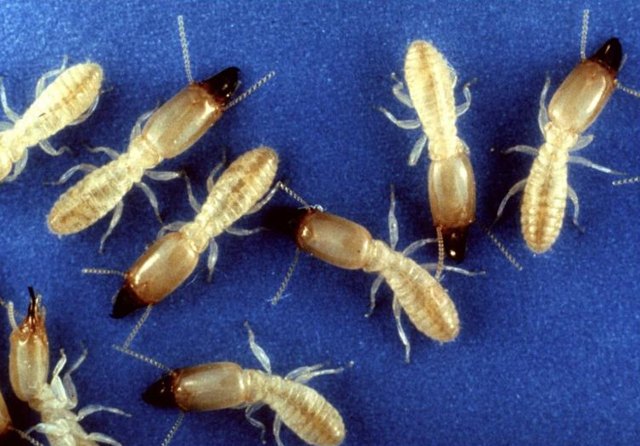
Pale subterranean termite soldiers with dark heads
Eastern subterranean termite soldiers. Photo: USDA Agricultural Research Service (public domain), via Wikimedia Commons.

Quick facts

Danger
Progressive structural damage to framing, sill plates, floors, and trim; often hidden until repairs are costly.
Season
Active year-round; swarms peak spring through early summer on warm, humid evenings, often after rain.
Common areas
Slab cracks and expansion joints, bath traps, plumbing and A/C penetrations, porch steps, garage joints, sill plates, tree stumps, fence and deck posts, mulch against the foundation.
Treatment
Conducive-condition repairs, a perimeter IGR bait system, targeted non-repellent spot treatments where needed, borate wood treatments, sealing, and scheduled monitoring. No blanket interior or baseboard sprays.

Risk meter

Nuisance Medium
Health None
Property Very high

Description and behavior

Subterranean termites live in soil and need moisture. They travel in mud tubes to reach wood and can enter through gaps as small as 1/16 inch. Foraging networks can span whole yards, linking landscape wood, stumps, and structures.

In Tampa Bay, spring swarms are common, and winged “swarmers” show up at windows and lights. Unlike drywood termites, subterranean termites line their galleries with soil and don’t leave pellet piles.

Signs of an infestation

  • Pencil-width mud tubes on foundations, piers, or inside garages
  • Discarded wings on windowsills, door tracks, or near lights (spring and early summer)
  • Blistered paint, soft or hollow-sounding wood, sagging floors
  • Wood with soil-lined galleries or moisture staining
  • Doors or windows suddenly sticking

Not all subterranean termites are equal

Tampa Bay has native termites plus two invasive heavyweights that UF researchers are tracking closely.

Eastern subterranean termite

Reticulitermes flavipes

  • Florida’s native, widespread species.
  • Soldiers make up only 1 to 2% of a colony.[1]
  • Slow, steady, and very common around homes.

Common

Formosan subterranean termite

Coptotermes formosanus

  • One colony can hold several million termites foraging up to 300 feet.[2]
  • About 10% of the colony are soldiers.[1]
  • Once established, it has never been eradicated from an area.[2]
Invasive

Asian subterranean termite

Coptotermes gestroi

  • UF scientists have confirmed heightened activity in Tampa.[3]
  • A tropical cousin of the Formosan termite.
  • Hybrids of the two invasive species are now confirmed in Florida.[4]
Invasive

Science says

Termites are a slow-motion problem with a fast-growing price tag. Here’s the research.

Millions

Colonies the size of cities

A single Formosan colony may contain several million termites.[2]

300 ft

Long-distance foragers

Formosan termites forage up to 300 feet through the soil.[2]

70,000+

Swarmers from one colony

A single Formosan colony may produce more than 70,000 winged swarmers.[2]

Tampa

The invaders are here

UF/IFAS has confirmed heightened invasive subterranean termite activity in Tampa.[3]

Prevention tips for Florida homes

  • Keep 4 to 6 inches of visible foundation; pull mulch 6 to 12 inches away and keep it 2 to 3 inches deep
  • Slope soil away from the home; extend downspouts 5 to 10 feet; avoid soaking the foundation daily
  • Repair leaks and sweating lines; insulate cold pipes over wood
  • Avoid wood-to-soil contact for steps, lattice, and posts
  • Store firewood and lumber off the ground and away from the house; remove stumps near foundations
  • Use treated lumber for ground contact; consider borate pre-treats during remodels
  • Don’t stack cardboard against walls; keep garages and attics ventilated

OrganoBug’s hybrid eco approach

  1. Confirm and map

    WDO inspection to verify subterranean vs. drywood and locate entry points, moisture sources, and active tubes.

  2. Fix conditions first

    Correct drainage and irrigation, repair leaks, pull mulch back, and eliminate wood-to-soil contact.

  3. Bait-first perimeter

    A colony-eliminating IGR bait system in locked stations around the home, with scheduled checks and re-baiting.

  4. Targeted direct treatments

    Non-repellent foams or liquids into tubes and voids where needed, plus borate on accessible wood. No blanket interior spraying.

  5. Seal and exclude

    Patch slab and garage cracks, seal utility penetrations, add bath-trap access covers.

  6. Monitor and protect

    Track stations over time and adjust as landscapes or weather change; pre-treat during remodels.

Frequently asked questions

How are subterranean termites different from drywood termites?

Subterranean termites live in soil, build mud tubes, and need moisture. Drywood termites live inside dry wood and push out pellets. Treatments differ.

Do you have to drill and flood my slab?

Not usually. Our bait-first program avoids blanket liquids. If targeted injections are needed, we do them precisely at entry points.

How long until the colony is controlled?

Baits work through the colony’s life cycle; we monitor and document steady decline while condition fixes remove the reasons they came.

Are your methods safe for kids, pets, and gardens?

Yes. Baits are in locked stations, and spot work uses reduced-impact, non-repellent products away from blooms.

I saw swarmers inside. Does that mean damage?

Swarmers mean a colony is nearby, but they aren’t a damage measure. We inspect, verify, and map activity before proposing treatment.

Can I DIY this with store products?

Store sprays rarely reach colonies and can repel termites away from baits. Professional baiting plus moisture fixes is far more effective.

Is Formosan a concern here?

Parts of Tampa Bay have invasive subterranean species with larger colonies. Our bait-first program covers them too.

Protect your biggest investment

We’ll confirm activity, fix the conditions, bait the colony, and keep your home protected year-round.

Sources and photo credits

  1. UF/IFAS EDIS, “Subterranean Termites” (IG097). edis.ifas.ufl.edu/publication/ig097
  2. Su and Scheffrahn, “Formosan Subterranean Termite, Coptotermes formosanus” (EENY-121 / IN278), UF/IFAS EDIS. edis.ifas.ufl.edu/publication/IN278
  3. PCT Online, “Asian Subterranean Termites Confirmed in Tampa” (quoting UF/IFAS researchers). pctonline.com
  4. “Hybrid Coptotermes Termites: Separating Fact from Fiction” (IN1476), UF/IFAS EDIS. edis.ifas.ufl.edu/publication/IN1476

Photo: USDA Agricultural Research Service, public domain, via Wikimedia Commons. Facts are summarized in our own words from the publications above. OrganoBug is not affiliated with or endorsed by the University of Florida.