
Home / Pest Library / Whiteflies
Ficus, rugose spiraling and silverleaf whiteflies · Tampa Bay
Whiteflies: a snowstorm nobody ordered.
Sap-sucking plant pests that swarm when disturbed and coat leaves in sticky honeydew. We protect landscapes with eco-smart, pollinator-safe methods. No blanket yard sprays.
Quick facts
- Danger
- Yellowing, leaf curl and drop, stunted growth; sticky honeydew leads to black sooty mold; plant decline if ignored.
- Season
- Year-round in Florida; pressure spikes spring through fall and after rains or heat waves.
- Common areas
- Ficus hedges, palms (areca and coconut), hibiscus, gardenia, citrus, vegetables, and ornamentals around pool cages and patios.
- Treatment
- Host-specific ID, plant-health fixes, pruning and washdowns, ant control, yellow sticky monitoring, targeted oils, soaps and reduced-impact products, and beneficial insects. Never broadcast over blooms.
Risk meter
Description and behavior
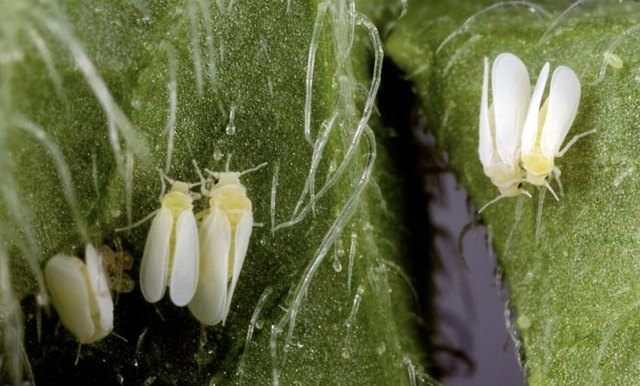
Whiteflies are tiny, white, moth-like insects that cluster on leaf undersides. Nymphs sit flat and feed continuously, while adults fly up in a snow-like cloud when plants are brushed.
They excrete honeydew, which grows black sooty mold and attracts ants that defend them. Different species specialize by host, but the damage pattern is similar: yellowing, curling, and leaf drop.
Signs of an infestation
- Clouds of small white insects when you touch leaves
- Sticky leaves, patio furniture, or cars parked nearby
- Black sooty mold on leaves and hardscapes
- Ant trails up plants
- Yellowing, cupping, or early leaf drop, especially on ficus and hibiscus
Science says
Florida has a lot of whiteflies. Here’s what UF researchers want homeowners to know.
Where the black mold comes from
Whiteflies excrete a sugary honeydew that grows black sooty mold, which can block photosynthesis and cause early leaf drop.[1]
The rugose spiraling signature
The rugose spiraling whitefly lays its eggs in spirals on leaf undersides, and even on cars and walls.[2]
The whitefly bodyguards
Ants feed on honeydew, so ants on a plant are a cue to check for sucking pests.[1]
Prevention tips for Florida homes
- Inspect new plants before planting; isolate if needed
- Rinse leaf undersides during peak months; thin shrubs for airflow
- Balance fertilization; avoid big nitrogen spikes and use slow-release
- Control ants around foundations and beds
- Remove weeds and volunteer hosts near beds; keep mulch off stems
- For edibles: row covers early, reflective mulch, and oils or soaps labeled for food crops
OrganoBug’s hybrid eco approach
Identify and map hosts
Confirm species and host plants, check leaf undersides for eggs and nymphs, and place yellow sticky monitors.
Strengthen plant health
Deep, infrequent irrigation, selective pruning for airflow, and no heavy nitrogen.
Mechanical and cultural controls
Hose leaf undersides, prune the worst growth, remove sooty-mold-coated leaves, and manage ants.
Targeted, low-impact treatments
Horticultural oils and soaps on leaf undersides, plus host-appropriate tools where needed, at dawn or dusk away from blooms.
Biological allies
Conserve or release parasitic wasps, lacewings, and lady beetles.
Monitor and refine
Recheck in 2 to 3 weeks and set a seasonal plan for hedges, palms, and edible beds. No canopy spraying.
Frequently asked questions
Will you spray the whole yard?
No. We target host plants and leaf undersides, not blooms or broad areas.
Is this safe for kids, pets, and edible gardens?
Yes. We favor washdowns, pruning, oils and soaps, and precise reduced-impact products with edible-crop guidance.
How fast will plants recover?
You’ll see less flight and honeydew within 1 to 3 weeks; new growth should come in cleaner.
Why do ants make it worse?
Ants guard whiteflies for honeydew and drive off natural predators. Light ant management is key.
Can whiteflies kill my ficus hedge or palms?
Severe, repeated infestations can cause dieback. Early action, pruning, and targeted eco treatments prevent decline.
Do sticky traps alone solve it?
Traps help monitor and catch some adults but don’t touch nymphs. They’re one tool in an integrated plan.
Clear the swarm
We’ll identify the species, protect pollinators, and restore your plants with precise, eco-smart care.
Sources and photo credits
- Buss, “Whiteflies on Landscape Ornamentals” (ENY-317 / MG254), UF/IFAS EDIS. edis.ifas.ufl.edu/publication/MG254
- “Rugose Spiraling Whitefly, Aleurodicus rugioperculatus” (IN1202), UF/IFAS EDIS. edis.ifas.ufl.edu/publication/IN1202
- UF/IFAS Extension Palm Beach County, “Rugose Spiraling Whitefly: A New Whitefly in South Florida” (2010). discover.pbc.gov
Photo: Stephen Ausmus, USDA Agricultural Research Service, public domain, via Wikimedia Commons. Facts are summarized in our own words from the publications above. OrganoBug is not affiliated with or endorsed by the University of Florida.